
Design for Manufacture, Assembly and Disassembly

Design for Disassembly (DfDA) and Design for Manufacture & Assembly (DfMA) are complementary design strategies that can be used to deliver a range of benefits and enable more circular outcomes.
Design for Manufacture and Assembly (DfMA)
Design for Manufacture and Assembly (DfMA) is a method that enables the off-site manufacture of building components in a controlled environment before being installed on-site. Standardised prefabricated modules can minimise waste and enable efficient use of resources.
Steel is well suited to DfMA design strategies through precision-engineered standard components and prefabrication methods using light gauge steel framing.
Case study: Ramsay Clinic Northside
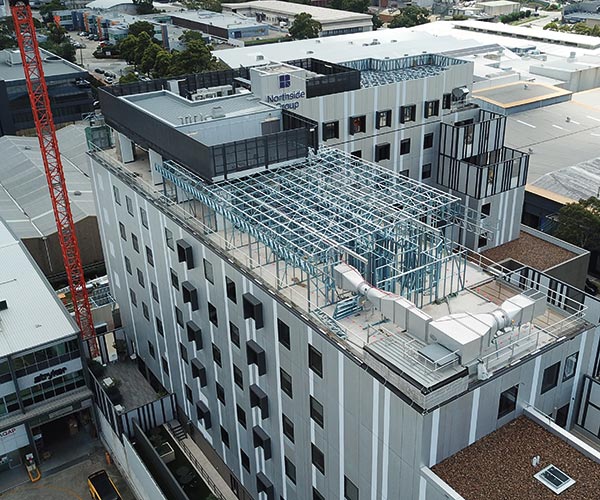
The extension of the Ramsay Clinic Northside in St Leonards, NSW, added an additional level using light gauge steel made from TRUECORE® steel. Prefabrication and Design for Manufacture and Assembly (DfMA) principles enabled large sections of the near complete facade system to be craned into position with minimal disruption to the fully operational facility. This project highlights how adaptive reuse can increase circularity and reduce embodied carbon compared to a new build.
Design for Disassembly (DfDA)
Design for Disassembly (DfDA) is a method of creating buildings, systems and products with components that can be removed without damage, enabling future reuse, repurposing or easy recycling.
Design for Disassembly is typically achieved with steel by using screw or bolted connections rather than welded joints and specifying connection details and fasteners that support future removal and reuse. With effective DfDA design strategies, steel can be reused well beyond its initial purpose and could contribute to reduced embodied carbon in future projects.
Case study: Western Sydney Stadium
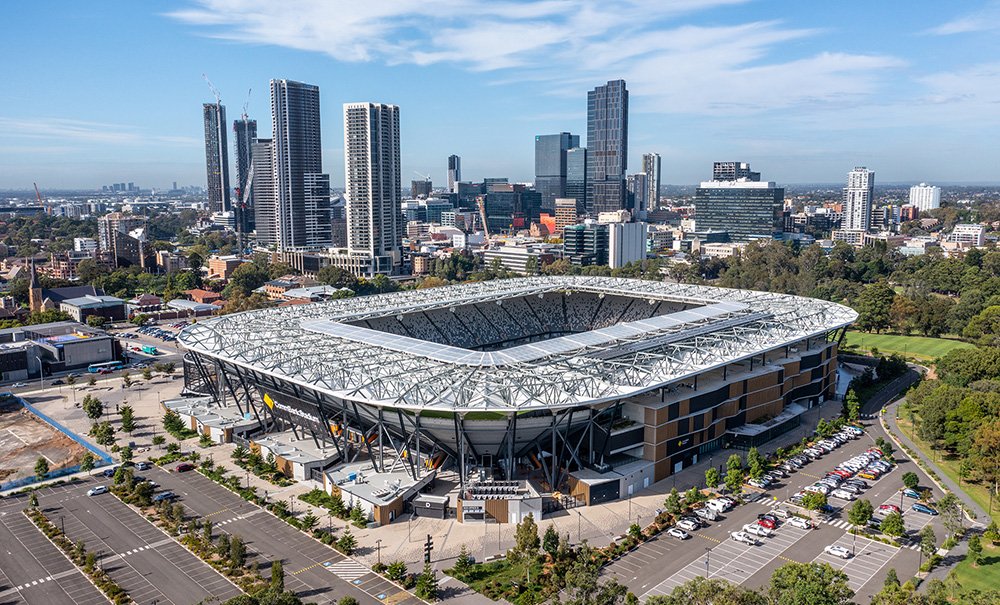
Western Sydney Stadium features a steel structure made from XLERPLATE® steel optimised for disassembly, and enabling future re-use. Unlike welded structures, its components can be unbolted, facilitating disassembly, relocation and reuse. Through this design strategy, steel can contribute to the circular economy by reducing future material consumption and enhancing resource efficiency.
Case study: COVID-19 Surge Centre
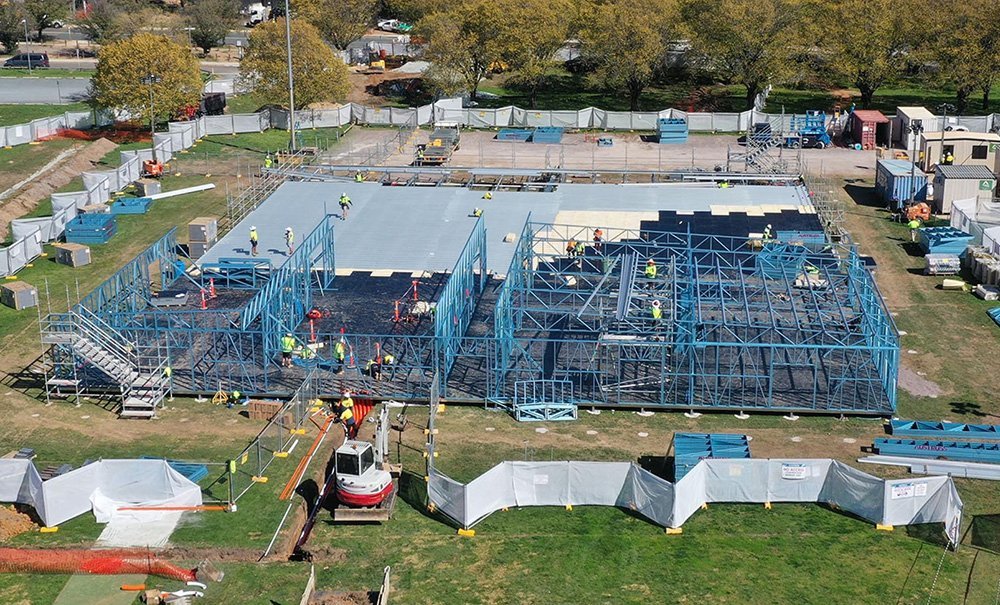
Light gauge steel frames made from TRUECORE® steel were used in nearly all the framing for the construction of the COVID-19 surge centre, utilising offsite prefabrication. Almost the entire structure was engineered to be flat-packed and relocated, enabling it to be re-established at a different location.
Further reading
Explore these topics to learn more about the key components of steel circularity.