
Dematerialisation

What is dematerialisation
Dematerialisation is a circular strategy aimed at reducing the quantity of materials required in a building design, while still meeting the functional and spatial requirements. It is achieved by intentionally designing for more efficient material use, particularly in the structural design.
Dematerialisation strategies for building design
Dematerialise building designs by reducing material inputs and prioritising reuse solutions. Consider dematerialisation opportunities early in the design process to minimise resources. For example, design options can be explored to maximise space and functionality while minimising material usage.
The GBCA Circular Procurement guide recommends specifying materials with a high strength to weight ratio to enable reduction of material volumes.
Steel solutions for dematerialisation
BlueScope manufactures a range of standard and high strength steel grades in plate and coil form. The high strength steel grades may enhance the strength to weight performance in structural steel applications when the design is governed by strength; by maximising the strength grade, a reduced volume of steel may be achieved in these applications, for example, smaller columns and primary members. This can lead to embodied carbon savings compared to a reference building design that utilises standard steel grades.
For low-to mid-rise buildings and multi-storey additions, precision engineered, structural framing made from light gauge steel can reduce the foundations required and reduce the requirements for hot rolled structural steel. TRUECORE® steel is ideal for structural framing in residential and many commercial applications, offering a high strength to weight ratio and the ability to achieve long spans and flexible designs.
Case study - dematerialisation
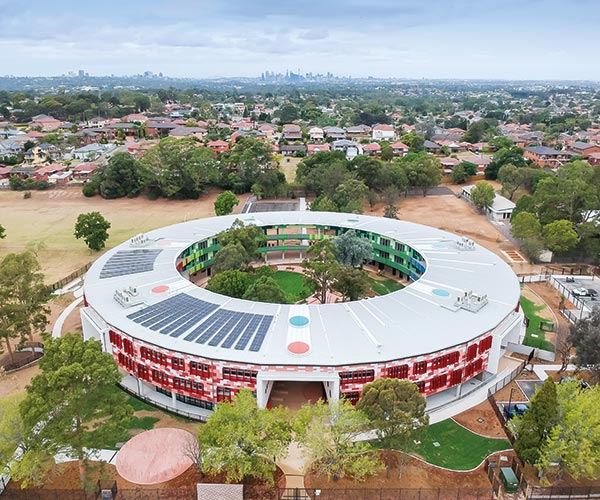
Smalls Road Public School, Ryde NSW
Prefabricated modules of TRUECORE® steel were assembled on-site and craned into position to form the upper-level wall frames and roof trusses of the Smalls Road School. The original design required 230 tonnes of structural steel to support the roof and walls on the upper level. By reworking the design and substituting this with light gauge steel frames made from TRUECORE® steel, almost 120 tonnes of steel was eliminated saving 469 tonnes of CO2-e emissions.
Further reading
Explore these topics to learn more about the key components of steel circularity.